From Washington to you
Pike Place Market
Pike Place Market · King County · opened August 17, 1907
Eight farmers met a crowd of nearly 10,000 on August 17, 1907. Seattle later voted to keep the market as “the soul of Seattle.”
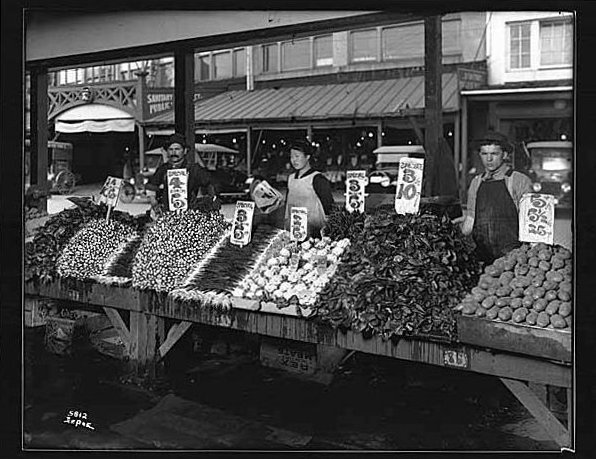
In 1907 the Seattle City Council designated newly planked Pike Place as a public market where people could buy produce straight from local growers. On the first rainy Saturday, August 17, 1907, eight farmers sold everything they brought to a crowd of nearly 10,000. Three months later, 120 farmers sold from wagons along the street. By the end of the year a shed with 76 stalls was under construction. By 1917 the Economy Market, Corner Market, Sanitary Market, and the lower levels of the Main Market were in place.
The city’s historic-preservation page calls Pike Place Market the oldest continuously operating and most historically authentic public market in the country. During World War II the Market lost more than half its farmers after Japanese American growers were incarcerated. By the 1960s fewer than 100 farmers remained.
A 1963 downtown plan proposed replacing much of the Market with Pike Plaza towers and a smaller updated market. Architect Victor Steinbrueck and Friends of the Market put the question on the November 1971 ballot. Seattle voted 73,369 to 53,264 to preserve it. The vote created a seven-acre local and National Register historic district and a larger 22-acre redevelopment area. The sources below are the City of Seattle historic-district page.
- History
- Music & Culture
Sources (2)
government · Tier S
City of Seattle Department of NeighborhoodsPike Place Market Historical District
government · Tier S
U.S. Geological SurveyPike Place Market (GNIS 1531897)
Last reviewed: September 21, 2026
Keep wandering
nearby
Alaska-Yukon-Pacific ExpositionSeattle's 1909 world's fair on the University of Washington campus drew millions of visitors and later gave Century 21 its golden anniversary to commemorate.
nearby
Great Seattle Fire, 1889A paint-shop fire at Front and Madison on June 6, 1889, burned for 18 hours, leveled 100 acres, and left the city to rebuild within a year.
nearby
Seattle and the Klondike stampedeA steamer landed in Elliott Bay with what the papers called a ton of gold. Seattle sold the rest of the rush its outfit.